
CAT4 Practice Test
Is your child taking the CAT4 Test? Give them the best chance to succeed by helping them prepare in advance. A strong CAT4 score can open doors to academic opportunities, gifted programs, and tailored support. We are here to walk you through what the CAT4 Test measures, explore sample practice questions, and get clear answers to parents’ most common questions.
What is the CAT4 Test?
The CAT4 Test (Cognitive Abilities Test, Fourth Edition) is a cognitive abilities test used by schools to understand how students learn, think, and solve problems. It is NOT based on taught curriculum subjects like math or reading. Instead, it focuses on a child's ability to reason across four key areas with two subsections:
Verbal Reasoning Battery
Tests understanding of word relationships, classifications, and analogies. It includes two subsections:
- Verbal Analogy: Each question shows three words in the form “A → B : C → ____.” A and B share a specific relationship. Students must identify this relationship and choose the word from five options that best relates to C in the same way.
- Verbal Classification: Questions provide three words and five answer choices. The student must select the word that belongs in the same category as the three given words.
Quantitative Reasoning Battery
Assesses numerical patterns, number analogies, and basic math reasoning.It includes two subsections:
- Number Analogy: Questions follow the format “A → B : C → ____,” where A, B, and C are numbers. The first two numbers have a mathematical relationship. The student must identify this relationship and select the number from five choices that relates to C in the same way.
- Number Series: Questions show a number sequence following a pattern. The student must identify the pattern and select the number from five options that correctly continues the series.
Non-Verbal Reasoning Battery
Measures ability to identify patterns, classifications, and analogies using shapes and figures. It includes two subsections:
- Figure Classification: Questions ask students to identify the connection between three shapes and select the one answer choice that shares the same characteristic or concept.
- Figure Matrices: Questions show a 2x2 matrix with shapes in the top row and the first box of the bottom row filled; the last box is empty. Students must identify the relationship between the top shapes and apply it to choose the correct shape to complete the matrix.
Spatial Ability Battery
Evaluates skills in visualizing, manipulating, and analyzing shapes and spatial relationships. It includes two subsections:
- Figure Analysis: Questions show paper folded and punched with holes. Students must choose which unfolded paper from five options matches the final product after folding.
- Figure Recognition: Questions present a single shape. Students must select the one complex design from five options that contains the same shape, size, and features.
FREE CAT4 Practice Test for each school year
CAT4 Practice Tests by School Year
CAT4 Level X & Y (Year 2 & 3): Basic reasoning skills in verbal, non-verbal, quantitative, and spatial areas, designed for younger students starting to develop problem-solving abilities.
CAT4 Level A (Year 4): Builds on foundational reasoning skills with more challenging verbal, non-verbal, quantitative, and spatial questions.
CAT4 Level B (Year 5): Focuses on improving reasoning and problem-solving across all four areas with increased difficulty.
CAT4 Level C (Year 6): Prepares students for transition to secondary school by testing stronger verbal, non-verbal, quantitative, and spatial reasoning.
CAT4 Level D (Year 7): Covers more advanced reasoning skills to support early secondary education demands.
CAT4 Level E (Year 8): Tests higher-level thinking in all four areas to challenge students in middle secondary school.
CAT4 Level F (Years 9 & 10): Focuses on complex problem-solving and reasoning relevant to later secondary education.
CAT4 Level G (Year 11+): The most advanced level, preparing students for further education by assessing strong cognitive abilities in all four reasoning areas.
Learn more with this CAT4 Test Prep
FREE CAT4 Test Sample Questions
Verbal Reasoning Battery
Verbal Reasoning - Verbal Analogies Question
Pen is to writer as brush is to...
- Painter
- Paper
- Paint
Answer
A. Painter
A pen is a tool used by a writer, just as a brush is a tool used by a painter. Paper and paint are materials, not the people who use the tools. Therefore, the correct answer is “Painter.”
Verbal Reasoning - Verbal Classification Question
Choose the word that belongs in the same group as the first three words.
Composer | Musician | Conductor
- Painter
- Singer
- Athlete
Answer
B. Singer
Composer, musician, and conductor are all related to music. Singer also fits in this group because it is a musical profession. Painter is related to art, and athlete is related to sports, so they don’t belong. Therefore, the correct answer is “Singer.”
Quantitative Reasoning Battery
Quantitative Reasoning Question - Number Analogies
6 → 18 9 → 27 7 → ?
- 14
- 24
- 21
- 30
Answer
C. 21
Each number on the left is multiplied by 3 to get the number on the right:
6 × 3 = 18 9 × 3 = 27 7 × 3 = 21
Quantitative Reasoning Question - Number Series
Which number completes the pattern?
22, 35, 28, 41, 34, 47, 40, 53, 46, ?
- 59
- 51
- 60
- 55
- 57
Answer
E. 57
This pattern has two alternating sequences:
Every other number increases by 13:
22 → 35 → 41 → 47 → 53 → 57
The numbers in between decrease by 7:
35 → 28 → 34 → 40 → 46
So the number that comes after 46 follows the “+13” pattern:
53 + 4 = 57
Thus, the next number in the sequence is 57.
Non-verbal Reasoning Battery
Non-Verbal Reasoning Question - Figure Classification

Answer
Each image has two shapes:
- An outer shape with diagonal lines
- An inner shape with fewer sides than the outer shape
Answer E follows this rule.
Non-Verbal Reasoning Question - Figure Matrices

Answer
On the top row, the shape on the left is doubled to make the shape on the right.
On the bottom row, the left shape has two triangles:
- A blue triangle with its base at the bottom
- A white triangle with its base at the top
So, the right shape should have:
- Two blue triangles with bases at the bottom
- Two white triangles with bases at the top
Only Answer C matches this.
Spatial Ability Battery
Spatial Ability Question - Figure Analysis

Answer
The paper is folded in half lengthwise, then folded again widthwise.
A heart shape is cut out of the folded paper.
When you unfold it widthwise, you get two hearts (a mirror image side by side).
Then, when you unfold it lengthwise, the two hearts are mirrored again, giving you four hearts in total.
- E is wrong: it doesn’t show four hearts.
- B, C, and D are wrong: the hearts aren’t mirrored correctly.
So, A is the only option that shows the correct pattern.
Spatial Ability Question - Figure Recognition

Answer

CAT4 Test Online FREE Practice Test
CAT4 Test FAQs
Who Uses the CAT4 Test?
More than 750,000 students take the CAT4 test each year in a variety of schools. It is widely used across primary schools, secondary schools, and independent schools throughout the United Kingdom. The test is also common in international schools across the United Arab Emirates-where it’s often required by the KHDA-as well as in countries like India, Singapore, and Hong Kong.
How is the CAT4 Test Administered?
The CAT4 is typically taken online in schools, though paper versions are available for those who need them. The test is usually supervised by teachers in a quiet classroom setting to ensure a fair environment. Each section is timed separately, and students complete a series of short, focused tests that assess different reasoning skills. Schools often schedule the test during regular school hours, and students may take the full assessment in one session or over multiple sessions depending on the school’s preference.
How Long is the CAT4 Test and What is Its Format?
The full CAT4 test takes about 2 hours and 15 minutes, divided into shorter timed sections totaling around 45 minutes of actual test time. It’s split into three main parts:
| Part | Section | Number of Questions | Time Allowed |
|---|---|---|---|
| Part 1 | Non-Verbal Reasoning • Figure Classification • Figure Matrices | 24 questions each | 10 minutes each |
| Part 2 | Verbal and Quantitative Reasoning 24 questions each (Verbal Classification, Verbal Analogies) 18 questions (Number Analogies) | 24 questions each (Verbal Classification, Verbal Analogies) 18 questions (Number Analogies) | 8 minutes each (Verbal sections) 10 minutes (Number Analogies) |
| Part 3 | Spatial Reasoning • Number series • Figure Analysis • Figure Recognition | 18 questions each | 8 - 9 minutes each |
Each section is timed separately and tests a specific type of reasoning.
When Do You Take the CAT4 Test?
Students typically take the CAT4 test when they are entering a new school or moving between key educational stages. The test is used for students aged 6 to 17, depending on the school system and country. In the UK, it is most commonly administered in Years 4, 6, 7, or 9 to support placement decisions and identify learning needs.
What are the CAT4 Testing Levels?
The CAT4 test is available in several levels, each of which is designed for a specific age group or academic level. The levels of the CAT4 are as follows:
| Age (years:months) | CAT4 Level | Year (UK) | Grade (US) |
|---|---|---|---|
| 6:00 - 7:11 | X | 2 | 1st |
| 6:06 - 8:11 | Pre-A | 3 | 2nd |
| 7:06 - 9:11 | A | 4 | 3rd |
| 8:06 - 10:11 | B | 5 | 4th |
| 9:06 - 11:11 | C | 6 | 5th |
| 10:06 - 12:11 | D | 7 | 6th |
| 11:06 - 13:11 | E | 8 | 7th |
| 12:06 - 15:11 | F | 9 & 10 | 8th & 9th |
| 13:06 - 16:11 | G | 11 | 10th |
| 14:06 - 17:00+ | H | 12 & 13 | 11th & 12th |
How is the CAT4 Test Scored?
The CAT4 test is scored using three main measures:
- Standard Age Scores (SAS): The average score is 100, with most students scoring between 85 and 115. Scores above 115 are above average, while those below 85 are below average.
- Percentile Ranks: These show the percentage of students your child scored better than. For example, a percentile rank of 70 means your child did better than 70% of students in the same age group.
- Stanines: These scores range from 1 to 9, with 5 as the average. Scores from 7 to 9 indicate above-average performance, 4 to 6 are average, and 1 to 3 are below average.
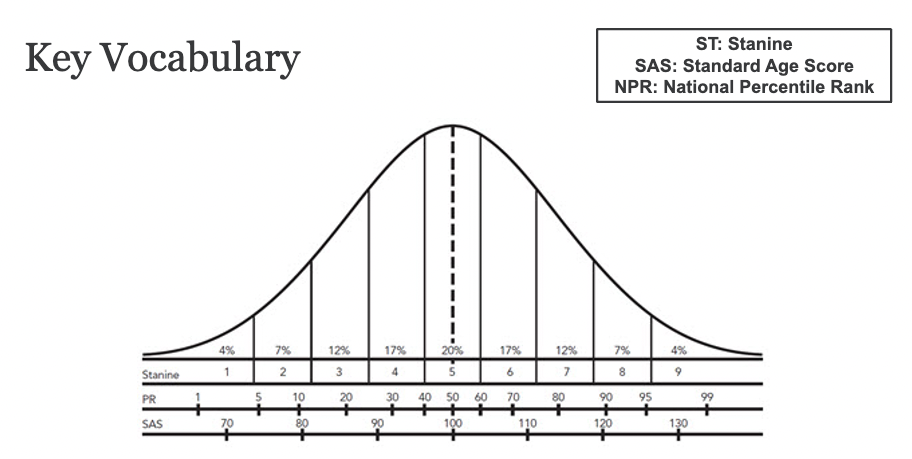
Understanding CAT4 Test Results
| Stanine | SAS band | Description |
|---|---|---|
| 1 | <74 | Very low |
| 2-3 | 74-88 | Below Average |
| 4-6 | 89-111 | Average |
| 7-8 | 112-126 | Above Average |
| 9 | >126 | Very High |
FREE CAT4 Practice Test PDF with answers
Who Uses CAT4 Test Results and Why?
CAT4 results are used by teachers, parents, school leaders, and admissions teams to understand student potential, guide teaching, set targets, and support placement decisions. Different reports provide tailored insights for each audience:
- Parent Report - Explains results in simple terms to help support learning at home.
- Student Report - Encourages self-awareness and learning goals.
- Teacher Report - Gives detailed scores to guide instruction and identify support needs.
- Group Report - Summarizes class data for grouping and planning.
- Excel Report - Offers flexible data for analysis and tracking.
- Combination Report - Combines CAT4 with other assessments for a fuller picture.
- Senior Leader Report - Highlights trends to inform school-wide planning.
These reports help schools make smarter, more personalized decisions for every learner.
What are CAT4 Scores Used For?
CAT4 scores are used for many different reasons:
School Admissions & Placement
- Used by selective, private, independent, and international schools for admissions and student grouping.
- High scores (SAS 115+) improve chances for top programs.
Gifted Program Entry
- SAS 120 - 129 = Highly able; 130+ = Gifted.
- Helps identify strengths, even in students with learning differences.
Academic Planning
- Schools use CAT4 to predict grades for GCSE, A-levels, IB, and CBSE exams.
- Guides subject choices and goal setting.
Targeted Support
- Highlights areas needing help.
- Supports tailored learning plans and early intervention.
- Low scores may reflect anxiety, EAL needs, or learning challenges.
School & Home Collaboration
- Teachers and parents use results to support learning.
- May prompt further evaluation if needed.
CAT4 Test Practice FREE Sample Questions
What CAT4 Scores are Needed to Qualify for Gifted & Talented Programs?
CAT4 scores can help schools identify students who may be gifted and talented by highlighting high levels of reasoning ability across different areas:
- High Scores (Above 120 or Stanine 8 - 9) in Verbal, Non-Verbal, Quantitative, or Spatial Reasoning can indicate strong potential.
- Students with very high Spatial scores may excel in STEM subjects and abstract thinking, even if verbal skills are average.
- CAT4 helps teachers spot students who may need advanced learning opportunities, enrichment, or differentiated instruction, especially if their classroom performance doesn't fully reflect their ability.
Schools often use CAT4 alongside teacher observations and academic performance to make Gifted & Talented program decisions.
What Can CAT4 Scores Reveal About KS2, GCSE, and A Level Performance?
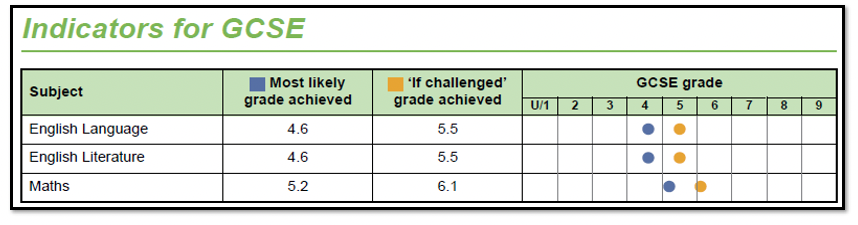
CAT4 scores predict a student’s future exam results by comparing their performance to extensive national and international data. By linking reasoning skills to likely academic outcomes, CAT4 provides two types of indicators: one showing expected achievement, and another highlighting what’s possible with additional support and challenge.
Key Stage 2 (KS2) tests, taken in England at the end of Year 6 (age 11), assess core subjects like English and math. CAT4 helps estimate how a student might perform in these tests, allowing teachers to set targets and provide early support.

GCSEs (General Certificate of Secondary Education) are exams taken at the end of Year 11 (age 16) in subjects such as math, English, and science. CAT4 predicts likely GCSE grades across both the 9 - 1 and A* - U grading systems, supporting schools in academic planning and personalized interventions.
A-levels are advanced exams taken in England, Wales, and Northern Ireland typically at the end of Year 13 (age 18). These exams cover specialized subjects and are key for university admission. CAT4 helps predict how a student might perform in A-levels, enabling teachers to set goals and tailor support for success.
Is the CAT4 Test Hard?
The CAT4 can be challenging because the test is designed to measure how students think and solve problems-not what they’ve been taught in school. For many students they have never experienced this type of question before.
How to Prepare for the CAT4 Test?
Preparing well for the CAT4 Test can open doors to gifted programs, advanced classes, and selective schools. Familiarity with the test’s recurring patterns greatly improves the chances of scoring higher, especially in sections like verbal analogies and classification-where building a strong vocabulary helps. Practicing with a real CAT4 sample test under timed conditions reduces test-day anxiety and helps students perform their best. This preparation not only boosts confidence but also highlights strengths and areas to improve, making sure the test results truly reflect your child’s abilities.
Have kids in multiple grades? Check out this family membership CAT4 Test Prep