
OLSAT Practice Test
The OLSAT Test (Otis-Lennon School Ability Test) is a widely used cognitive assessment that plays a key role in identifying gifted and talented students from kindergarten through 12th grade. Preparing for the OLSAT helps students become familiar with question types, improve performance, and reduce test anxiety. We will walk you through how the test works, sample questions, and what to expect by grade level.
| OLSAT Level A: Kindergarten | OLSAT Level B: 1st Grade | OLSAT Level C: 2nd Grade |
| OLSAT Level D: 3rd Grade | OLSAT Level E: 4th and 5th Grades | OLSAT Level F: 6th - 8th Grades |
| OLSAT Level G: 9th - 12th Grades |
What is the OLSAT Test?
The OLSAT (Otis-Lennon School Ability Test) is a standardized, multiple-choice assessment designed to measure abstract thinking and reasoning skills in children from Pre-K to 12th grade. It's² commonly used by schools to identify gifted students for special academic programs. The test evaluates both verbal and nonverbal cognitive skills, providing insight into a student's ability to learn, understand relationships, and solve problems.
Verbal Section
Measures language-based reasoning through tasks like:
- Following Directions - Understanding and executing multi-step instructions
- Arithmetic Reasoning - Solving word problems using logic
- Aural Reasoning - Listening and drawing conclusions
- Analogies and Classifications - Identifying relationships between concepts and grouping similar items
Nonverbal Section
Assesses visual and spatial reasoning through:
- Pattern Completion - Identifying missing parts of patterns
- Figural Reasoning - Solving shape-based analogies
- Picture Classification - Grouping images with shared characteristics
- Series Completion - Determining the next image in a sequence
Quantitative Section
Beginning with OLSAT Level D (3rd grade), the test introduces more advanced quantitative reasoning tasks, including:
- Number Series - Identifying patterns and predicting the next number
- Arithmetic Reasoning - Applying logical thinking to math word problems
- Quantitative Comparisons - Comparing numerical values or expressions
- Basic Number Operations - Understanding addition, subtraction, multiplication, and division in problem-solving contexts
OLSAT Practice Test by Grade Level
OLSAT Test Level A (Kindergarten) - Focuses on basic pattern recognition, picture classification, and listening to verbal directions.
OLSAT Test Level B (1st Grade) - Introduces more advanced visual reasoning, early logic, and verbal comprehension skills.
OLSAT Test Level C (2nd Grade) - A key entry point for gifted programs. Covers figural series, arithmetic reasoning, and verbal analogies.
OLSAT Test Level D (3rd Grade) - Expands to multi-step reasoning, complex patterns, and classification tasks.
OLSAT Test Level E (4th - 5th Grades) - Increases difficulty with abstract logic, verbal inference, and enriched reasoning skills.
OLSAT Test Level F (6th - 8th Grades) - Emphasizes advanced problem-solving, figural reasoning, and verbal analysis for middle school placement.
OLSAT Level Test G (9th - 12th Grades) - Targets high school students with challenging verbal and nonverbal reasoning for academic placement and enrichment.
FREE OLSAT Test Practice Questions
OLSAT Sample Questions Level A
Verbal Question
Select the picture that shows a spaceship first, an alien second, and an astronaut last.

Answer
Answer: CNon-Verbal Question
The two pictures at the top are related in a specific way. Pick the picture that relates to the bottom picture in the same way the top two pictures do.

Answer
Answer: BOption B shows pairs of opposites-like happy/sad and cold/hot-making it the correct choice.
FREE OLSAT Level A Practice Test
OLSAT Sample Questions Level B
Verbal Question
Jayden and Marin bought 8 lollipops in total, as shown below. They each ate 2, and their friend Madeline ate 1. How many lollipops remain?

Answer
Answer: CJayden and Martin bought 8 lollipops. Jayden ate 2, Martin ate 2, and Madeline ate 1. They ate 5 lollipops total.
So, 8 minus 5 equals 3 lollipops left
Non-Verbal Question
Which picture does not belong?
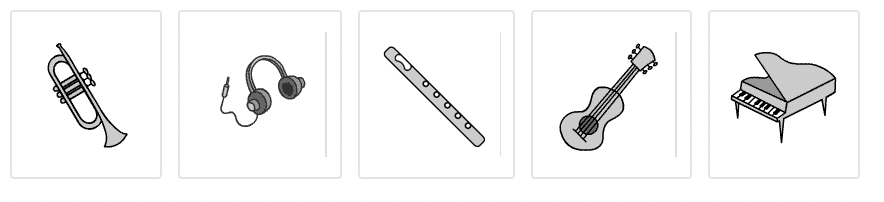
Answer
Answer: BThe headphones are the only item which is not a musical instrument.
FREE OLSAT Level B Practice Test
OLSAT Sample Questions Level C
Verbal Question
Select the picture with a small triangle pointing up to the right of a large triangle pointing down, and a star to the left of a small circle.

Answer
Answer: CNon-Verbal Question
Look at the figures below. They go together in a certain way. Can you point to the one that doesn't belong?

Answer
Answer: DChoices A, B, and C each have three stars nested inside each other. Choice D only has two stars nested.
FREE OLSAT Level C Practice Test
OLSAT Sample Questions Level D
Verbal Question
Choose the word that is most opposite in meaning to hesitant:
- A. certain
- B. doubtful
- C. cautious
- D. nervous
Answer
Answer: A"Hesitant" means unsure or slow to act. The opposite is certain, which means confident and sure.
Non-Verbal Question
The pictures in the box are related in a specific way. Pick the picture that fits in the empty space.

Answer
Answer: CAcross each row, the shapes increase by one side-triangle (3), square (4), pentagon (5). Down each column, the shapes have the same number of sides and the same color.
Only choice C follows both rules, so it's the right answer.
Quantitative Reasoning
The numbers in the box follow a pattern. Figure out the rule, then choose the number that should replace the question mark.

- 0
- 4
- 10
- 14
Answer
Answer: DThe numbers follow a pattern: the second number is 7 more than the first.
10 → 17 (10 + 7)
21 → 28 (21 + 7)
In the last box, the first number is 7. Add 7: 7 + 7 = 14
FREE OLSAT Level D Practice Test
OLSAT Sample Questions Level E
Verbal Question
If Ava is older than Lily, and Zoe is younger than Lily, then we can say that:
- A. Ava is older than Zoe
- B. Lily is older than Ava
- C. Ava is younger than Zoe
- D. Zoe is older than Lily
- E. Zoe and Ava are the same age
Answer
Answer: A
Ava is older than Lily, and Lily is older than Zoe.
So, Ava is also older than Zoe.
Non-Verbal Question

Answer
Answer: BThe second shape is the first shape rotated 90° counterclockwise with a triangle added on top.
To follow the same pattern, rotate the third shape 90° counterclockwise and add a triangle.
Quantitative Reasoning Question
What comes next?
3 2 3 4 3 6 3 8 3 ?
- A. 9
- B. 10
- C. 11
- D. 12
- E. 13
Answer
Answer: BEvery other number is 3
The numbers in between go up by 2: 2, 4, 6, 8, ?
So the next number after 8 is 10.
FREE OLSAT Level E Practice Test
OLSAT Sample Questions Level F
Verbal Question
Which word does not belong with the other four?
- A. sprint
- B. jog
- C. dash
- D. leap
- E. run
Answer
Answer: D. leap All the other words-sprint, jog, dash, and run-describe ways of running or moving quickly on foot. Leap means to jump, which is a different kind of movement.
Non-Verbal Question
Look at the first pictures in the row-they follow a pattern. One picture is missing. Which picture completes the pattern?

Answer
Answer: EEach frame has shapes on the left and a circle on the right.
The shapes decrease by 1 each time: 7, 6, 5… so the next should have 4 shapes.
The circle is divided into more parts each time: 1, 2, 3… so the next should have 4 sections.
The missing frame has 4 shapes and a circle split into 4 parts.
Quantitative Reasoning
The numbers in the box follow a specific pattern. Pick the number that should replace the question mark.

- A. 31
- B. 25
- C. 29
- D. 33
- E. 27
Answer
Answer: EAcross each row, the pattern is: subtract 5, then add 3.
Down each column, the pattern is: add 4 each time.
Using these:
The last row's second number is 24, so 24 + 3 = 27.
The second row's last number is 23, so 23 + 4 = 27.
Since 27 fits both patterns, it's the right answer.
FREE OLSAT Level F Practice Test
OLSAT Sample Questions Level G
Verbal Question
If the words below were arranged to make the best sentence, which letter would the last word of the sentence begin with?
early have students their homework always completed on time
- e
- h
- o
- t
- s
Answer
Answer: D
The sentence reads: Students have always completed their homework on time. The last word is time, which starts with the letter T.
Non-Verbal Question
Choose the shape that matches the pattern of the given matrix:

Answer
Answer: EHere are the two main rules:
Circle:
Moves one column right across a row
Stays in the same column down a column
Star:
Moves up one row across a row
Moves one column left down a column
So, E is the correct answer because it's the only choice that follows both the circle's and star's movement rules.
Quantitative Reasoning
The numbers in the box follow a pattern. Figure out the rule and pick the missing number.

- 0
- 1
- 3
- 4
- 5
Answer
Answer: EPattern Rule:
First number × 12 = Second number
Second number × 0 = Third number
Examples:
Box 1: 4 × 12 = 48, then 48 × 0 = 0
Box 2: -2 × 12 = -24, then -24 × 0 = 0
For the question mark box:
Second number is 60
First number = 60 ÷ 12 = 5
Check: 5 × 12 = 60, 60 × 0 = 0
So, the first number is 5. Answer E is correct.
FREE OLSAT Level G Practice Test
OLSAT Test FAQs
What Purpose Is the OLSAT Test Used For?
The OLSAT Test identifies students with strong reasoning and problem-solving skills, often for placement in gifted and talented (G&T) programs. It helps schools understand a child's cognitive potential beyond traditional academic grades and supports decisions about enrichment opportunities.
Who Uses the OLSAT Test?
The OLSAT is used by school districts across the United States to identify students for gifted and talented programs. It's especially common in large urban districts such as New York City, Los Angeles Unified, Chicago Public Schools, Houston ISD, and Miami-Dade County. Many suburban and private schools also use the OLSAT as part of their gifted screening process. While usage varies by region, the test is popular in states like California, Texas, Florida, Illinois, and New York, where gifted programs are more formally structured and competitive.
How Is the OLSAT Test Administered?
The OLSAT is typically administered in schools, either online or on paper, depending on the district. For younger students, the test may be read aloud by a teacher, while older students complete it independently. The format and administration vary slightly by grade level and OLSAT version.
How Long Is the OLSAT Test?
The OLSAT takes approximately 60 - 75 minutes, including instructions. It contains between 40 and 72 questions, depending on the student's grade level.
What Are the OLSAT Testing Levels?
| OLSAT Test Level | Grade | Number of Questions | Test Time |
|---|---|---|---|
| Level A | Kindergarten | 40 | ~60 minutes |
| Level B | 1st Grade | 60 | ~77 minutes |
| Level C | 2nd Grade | 60 | ~77 minutes |
| Level D | 3rd Grade | 64 | ~77 minutes |
| Level E | 4th-5th Grade | 72 | ~77 minutes |
| Level F | 6th Grade | 72 | ~77 minutes |
| Level G | 7th-8th Grade | 72 | ~77 minutes |
| Level H | 9th-10th Grade | 72 | ~77 minutes |
| Level I | 11th-12th Grade | 72 | ~77 minutes |
Note: The number of questions and test duration may vary slightly depending on whether the test is administered online or on paper, and whether it's read aloud for younger students.
What Is the Format of the OLSAT Test?
The OLSAT is a multiple-choice test. Younger students may answer picture-based questions, while older students face more abstract verbal and figural tasks. Questions are grouped into subcategories under verbal and nonverbal reasoning.
When Is the OLSAT Test Given?
The OLSAT is usually given once a year during the fall or spring, depending on district policies. Schools coordinate the exact testing dates, and parents are usually notified in advance.
How Is the OLSAT Test Scored?
Scores are based on the number of correct answers and reported as:
Raw Score - The total number of correct answers
School Ability Index (SAI) - A normalized score with a mean of 100 and a standard deviation of 16
Percentile Rank - Shows how a student performed compared to same-age peers
Stanine - A simplified score on a 1 to 9 scale, where 5 is average, and scores of 7 - 9 typically indicate above-average ability often required for gifted program eligibility
SAI (School Ability Index) - The OLSAT reports scores using the SAI, where the average is set at 100. A higher SAI indicates stronger reasoning and problem-solving ability compared to peers.
Understanding OLSAT Scores
| Stanine | Score Range (SAI) | Percentile Rank | Description |
|---|---|---|---|
| 9 | 130-160 | 96-99 | Very High (Gifted Range) |
| 7-8 | 118-129 | 77-95 | Above Average |
| 4-6 | 101-117 | 23-76 | Average |
| 2-3 | 89-100 | 9-22 | Below Average |
| 1 | 80-88 | 1-8 | Well Below Average |
Can You Fail the OLSAT Exam?
The OLSAT has no pass or fail. It's a norm-referenced assessment, meaning students are compared to peers rather than judged by fixed criteria. However, a low score may mean the student does not qualify for certain gifted programs.
What Happens if You Score High on the OLSAT Test?
Scoring high may make a student eligible for gifted and talented programs, enrichment classes, or accelerated learning tracks. It can open doors to specialized instruction, creative problem-solving opportunities, and advanced coursework, boosting motivation and long-term academic growth.
Gifted OLSAT Score Chart
| Score Type | Typical Gifted Cutoff |
|---|---|
| SAI (School Ability Index) | 125-130+ |
| Stanine | 8 or 9 |
| Percentile Rank | Top 5%-10% nationally |
Note: Gifted program entry requirements vary by school district, but most rely on the OLSAT interpretation of an SAI score of 125 or higher as a common benchmark for qualification.
How Can You Prepare for the OLSAT Test?
Preparing for the OLSAT is key-especially since a high score can lead to placement in gifted and talented programs that shape your child's academic future. These programs offer advanced learning, enriched environments, and early access to challenging material. Many students struggle with the test format and timing, so preparation is essential. We recommend this OLSAT Reviewer with practice OLSAT-style questions that mimic the style and format of the actual test. Strengthening verbal and nonverbal reasoning through puzzles, analogies, and pattern recognition sharpens core skills. With the right prep, your child can approach the test with confidence and unlock greater opportunities.
OLSAT Test Prep
| OLSAT Level A: Kindergarten | OLSAT Level B: 1st Grade | OLSAT Level C: 2nd Grade |
| OLSAT Level D: 3rd Grade | OLSAT Level E: 4th and 5th Grades | OLSAT Level F: 6th - 8th Grades |
| OLSAT Level G: 9th - 12th Grades |
Note: The number of questions and test duration may vary slightly depending on whether the test is administered online or on paper, and whether it's read aloud for younger students. If you have more than one child testing take a look at this family membership preparation pack.Check out this family membership OLSAT Test Prep.