
Renaissance STAR Testing Practice Test
The STAR Test by Renaissance is a widely used adaptive assessment designed to measure a student's academic progress in reading, math, and early literacy. Administered in schools across the U.S., it helps teachers identify student needs, track growth, and guide personalized instruction. We are here to walk you through what to expect on the test and give you sample questions and answers.
FREE STAR Renaissance Practice Tests
| STAR Test Early Literacy | STAR Test for 1st and 2nd Grade | STAR Test for 3rd and 4th Grade |
| STAR Test for 5th and 6th Grade | STAR Test for 7th and 8th Grade |
What is the STAR Test?
The STAR Test (Standardized Test for the Assessment of Reading and Math) is a computer-adaptive assessment that adjusts question difficulty based on student responses. It is commonly used in grades K-12 and includes the following major components:
STAR Early Literacy
The STAR Early Literacy Test, designed for early learners from Pre-K to Grade 2, evaluates essential reading and math readiness skills. The test includes multiple-choice questions across nine core literacy domains and one numeracy domain, each targeting a specific foundational skill. Here's a brief explanation of each:
- Alphabetic Principle (Pre-K-K): Assesses how well a child understands the connection between letters and their corresponding sounds.
- Concept of Word (Pre-K-K): Measures the ability to track words in print while reading aloud, linking spoken and written language.
- Visual Discrimination (Pre-K-K): Tests how well a child can recognize and distinguish between letters and shapes that look similar.
- Phonemic Awareness (Pre-K-1): Focuses on recognizing and manipulating the individual sounds (phonemes) within spoken words.
- Phonics (K-3): Evaluates a child's skill in matching letters or letter patterns with their sounds to decode words.
- Structural Analysis (1-3): Looks at the ability to break down words into meaningful parts like prefixes, suffixes, or root words.
- Vocabulary (K-3): Measures understanding of word meanings, often using images to match words with their definitions.
- Sentence-Level Comprehension (1-3): Tests how well a student understands the meaning of individual sentences.
- Paragraph-Level Comprehension (1-3): Assesses understanding of short passages, focusing on reading comprehension.
- Early Numeracy (10th domain): Covers basic math concepts like number recognition, counting, and simple problem-solving.
STAR Reading Test
The STAR Reading test assesses reading comprehension and skills through multiple-choice questions that span several key literacy domains. These domains are designed to evaluate how well students read, understand, and interpret texts:
- Word Knowledge and Skills: Assesses vocabulary understanding, including synonyms, antonyms, and word meanings in context.
- Comprehension Strategies and Constructing Meaning: Measures the ability to draw conclusions, make inferences, and understand main ideas and supporting details.
- Analyzing Literary Text: Focuses on understanding elements of fiction, such as setting, character, plot, and theme.
- Understanding Author's Craft: Evaluates how authors use language, tone, and structure to convey meaning or create a mood.
- Analyzing Argument and Evaluating Text: Tests critical thinking by analyzing claims, evidence, and persuasive techniques used in various texts.
STAR Math Test
The STAR Math test includes multiple-choice questions that cover essential math concepts and problem-solving skills aligned with grade-level standards. Here's a breakdown of the key domains:
- Numbers and Operations: Covers basic arithmetic, place value, and number sense, including whole numbers, fractions, and decimals.
- Algebra: Assesses patterns, expressions, and equations, as well as understanding variables and solving for unknowns.
- Geometry: Focuses on shapes, spatial reasoning, and properties of angles, lines, and figures.
- Measurement: Involves concepts of length, volume, weight, time, and using appropriate tools and units to measure.
- Data Analysis, Statistics, and Probability: Evaluates the ability to read graphs, interpret data, calculate averages, and understand probability concepts.
- Ratios and Proportional Relationships (Grades 6+): Tests understanding of ratios, proportions, percentages, and their applications in problem-solving.
Take a STAR Practice Test Online
STAR Practice Test by Grade Level
- Kindergarten STAR Test - Focuses on early literacy and foundational math. Helps identify students who may need early interventions.
- 1st Grade STAR Test - Measures developing reading and math skills, including word recognition and simple arithmetic.
- 2nd Grade STAR Test - Assesses reading fluency, comprehension, and more advanced math concepts like multi-digit operations.
- 3rd Grade STAR Test - Reading questions include longer passages and more inferential reasoning. Math includes geometry, fractions, and multi-step problems.
- 4th Grade STAR Test - Reading questions emphasize nonfiction, main idea, and text evidence. Math includes decimals, multi-digit multiplication, and word problems with data interpretation.
- 5th Grade STAR Test - Reading includes paired passages, cause and effect, and theme analysis. Math covers volume, coordinate planes, and advanced fractions and decimals.
- Middle & High School STAR Tests - Reading assesses literary analysis and nonfiction comprehension. Math expands to algebra, data analysis, and geometry concepts.
Have more than one child taking a STAR Test? Check out our family membership STAR Test Practice Test options.
FREE STAR Test Practice Questions
STAR Early Literacy Sample Question
1. Which letter comes right before “T” in alphabetical order?
- S
- V
- U
Answer
Answer: A.
2. Liam wrote down a few things he needs for school:
- Notebook
- Pen
- Eraser
- Ruler
Which item has the fewest letters?
- The first item
- The second item
- The fourth item
Answer
Answer: B
3. Which of the following words has a long /a/ sound?
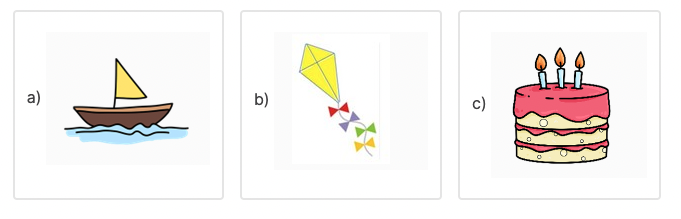
Answer
Answer: C
4. What prefix can you add to the word “happy” to make it mean not happy?
- dis
- un
- in
Answer
Answer: B. un
5. Tom felt tired after playing outside all day.
Which word means the same as tired?
- energetic
- sleepy
- excited
Answer
Answer: B. sleepy
6. Read the paragraph below:
Liam went to the park with his dad. He played on the swings, fed the ducks, and climbed the big slide. Liam had a great time and didn't want to leave.
What is the main idea of this paragraph?
- Liam's fun day at the park
- How to feed ducks at the park
- Liam's dad likes to swing
Answer
Answer: A) Liam's fun day at the park
7. Lisa spotted 5 butterflies in the garden. Then, one more butterfly flew in to join them. How many butterflies are there in total now?
Use the pictures to help you find the answer:

- 4
- 5
- 6
Answer
Answer: C
Renaissance STAR Early Literacy Test Practice Questions
STAR Reading Sample Questions
STAR Reading Test Practice Question - Word Knowledge and Skills
The girl felt exhausted after running a long race.
Which word means the same as exhausted?
- happy
- tired
- excited
Answer
Answer: B
The word "exhausted" means very tired.
STAR Reading Test Practice Question - Vocabulary in Context
Choose the word that best completes the sentence:
The teacher asked the students to ___ their homework before class.
- submit
- subtract
- submit
Answer
Answer: A
The correct word is "submit," which means to hand in or turn in something, like homework.
STAR Reading Test Practice Question - Comprehension Strategies and Constructing Meaning
Read the passage:
Cats are known for their independence and curiosity. They often explore their surroundings quietly and enjoy spending time alone. Many people keep cats as pets because of their playful nature and low maintenance needs.
Which sentence shows an opinion?
- Cats are known for their independence and curiosity.
- Many people keep cats as pets because of their playful nature and low maintenance needs.
- Cats often explore their surroundings quietly.
Answer
Answer: B
Sentence B shows an opinion because it suggests why people like cats, which can vary from person to person.
STAR Reading Test Analyzing Short Literary Text Practice Question
Read the passage.
A girl was exploring the garden, noticing the colorful butterflies and tall sunflowers swaying in the breeze. She saw bees buzzing from flower to flower and heard birds singing nearby. Suddenly, she spotted a small rabbit hiding behind a bush, and she smiled with delight.
Where does this story take place?
- inside a house
- in the garden
- at school
Answer
Answer: B. in the garden
The story describes plants, butterflies, and animals typically found in a garden, so the correct setting is B, in the garden.
STAR Reading Test Understanding Author's Craft Practice Question
Read the lines below and answer the question:
The moon shone bright like a silver lantern,
Guiding the travelers through the night.
Which phrase is a simile?
- The moon shone bright
- like a silver lantern
- Guiding the travelers
Answer
Answer: B) like a silver lantern
A simile compares two things using “like” or “as.” Here, the moon is compared to a silver lantern using “like,” so B is the simile.
STAR Reading Analyzing Argument and Evaluating Text Sample Question
Which sentence creates the clearest image for the reader?
- The garden was full of blooming flowers and buzzing bees.
- She felt disappointed when her friend forgot her birthday.
- The classroom was messy after the art project.
Answer
Answer: A) The garden was full of blooming flowers and buzzing bees.
This sentence uses descriptive words like “blooming flowers” and “buzzing bees” to create vivid imagery, so A is the best choice.
Renaissance STAR Reading Test Practice Questions
STAR Math Sample Questions
STAR Math Test Practice Question - Numbers and Operations
Look at the following number sequence:
5, 8, 11, 14, 17, ___
What is the next number in the sequence?
- 19
- 20
- 21
Answer
Answer: C) 20
The sequence increases by 3 each time (5 + 3 = 8, 8 + 3 = 11, etc.), so the next number is 17 + 3 = 20.
STAR Math Test Sample Question Data Analysis, Statistics, and Probability
How many dogs weighed 50 kilograms or more?
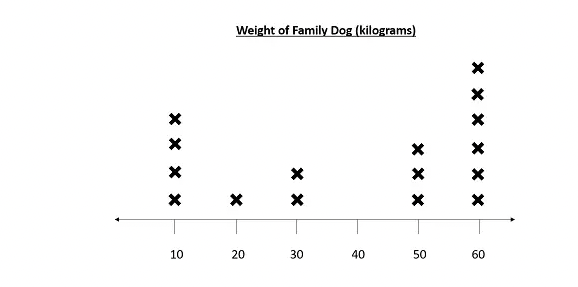
- 3
- 7
- 9
- 10
Answer
Answer: C
Each "x" represents one dog. We need to count dogs weighing 50 kg or more. There are 3 dogs at 50 kg and 6 dogs at 60 kg. 3 + 6 = 9 dogs weigh at least 50 kg.
STAR Math Test Sample Question - Algebra
Solve for x:
2x + 7 = 19
- 5
- 6
- 7
Answer
Answer: A) 6
Subtract 7 from both sides: 2x = 12, then divide by 2: x = 6.
STAR Math Test Sample Question - Data Analysis and Probability
A spinner is divided into 8 equal sections numbered 1 through 8. What is the probability the spinner will land on a number greater than 6?
- 1/4
- 1/2
- 1/8
- 1/3
Answer
Answer: A) 1/4
Numbers greater than 6 are 7 and 8, which are 2 out of 8 sections. So, the probability is 2/8 = 1/4.
STAR Math Test Sample Question-Geometry and Measurement
Which of the following is an isosceles triangle?

Answer
Answer: B
An isosceles triangle has two equal angles.
Renaissance STAR Math Test Practice Questions
STAR Testing FAQs
What Purpose Is the STAR Test Used For?
STAR assessments help teachers understand your child's reading and math levels so they can provide the right support. STAR Reading and Math are used to guide placement in programs like Accelerated Reader™ and Accelerated Math™, while STAR Early Literacy tracks young children's progress toward becoming independent readers. These tests also help teachers monitor growth, check how students are meeting state standards, and identify the skills your child is ready to learn next. Many schools use it for RTI (Response to Intervention) programs.
Who Uses the STAR Test?
The STAR Test is used by schools across the United States and in several other countries. In the U.S., it's widely adopted in states like California, Texas, Florida, New York, and Illinois to monitor student progress in reading and math. Internationally, STAR is also used in schools in Canada, the United Kingdom, Australia, and parts of Asia and the Middle East. Its popularity continues to grow as educators seek efficient, data-driven tools to support student learning.
How Is the STAR Test Administered?
The STAR Test is administered online through a secure testing platform, usually on school computers or tablets. Students take the test at school, often in a classroom or computer lab, under the supervision of a teacher or proctor. The results are available quickly to help teachers guide instruction.
How Long Is the STAR Test?
Each STAR test typically takes 20-30 minutes to complete. It's designed to be brief while providing accurate insights into a student's abilities.
What Is the Format of the STAR Test?
The STAR Test uses multiple-choice questions and is computer-adaptive. This means questions become easier or harder based on a student's previous answers, creating a customized assessment experience.
When Is the STAR Test Given?
Most schools give the STAR Test three times per year-fall, winter, and spring-to monitor student growth. Some districts may also use it for progress checks throughout the year.
What Are the STAR Testing Levels?
| Grade Level | Test | ||
|---|---|---|---|
| Number of Questions | Test Time | Pre-K - Kindergarten | STAR Early Literacy |
| ~27 | ~20 minutes | Grade 1 | STAR Early Literacy / STAR Reading / STAR Math |
| ~27 / ~34 | ~20 / ~20-30 minutes | Grade 2 | STAR Reading / STAR Math |
| ~34 | ~20-30 minutes | Grade 3 | STAR Reading / STAR Math |
| ~34 | ~30 minutes | Grade 4 | STAR Reading / STAR Math |
| ~34 | ~30 minutes | Grade 5 | STAR Reading / STAR Math |
| ~34 | ~30 minutes | Grades 6-12 | STAR Reading / STAR Math |
Note: STAR tests are computer-adaptive, so the number of questions and timing may vary slightly by student performance. STAR Reading and Math typically have up to 34 questions.
What's the Difference Between the STAR Reading Test and the Early Literacy Test?
The STAR Early Literacy Test is for students in pre-K through early Grade 2. It assesses foundational skills like phonics, vocabulary, and print concepts. The STAR Reading Test is for more advanced readers in Grade 1 and up. It focuses on reading comprehension, vocabulary, and text analysis. Students usually start with Early Literacy and transition to the Reading Test once they show readiness.
How Is the STAR Test Scored?
STAR scores are based on Item Response Theory (IRT). Students receive:
Scaled Score (SS):
- Measures performance based on question difficulty and accuracy.
- Used to track progress across time and grade levels (range: 0-1400).
Percentile Rank (PR):
- Compares your child to peers nationwide in the same grade.
- A PR of 85 means they scored as well as or better than 85% of students.
Grade Equivalent (GE):
- Shows the grade level and month your child is performing at (e.g., 4.6 = 4th grade, 6th month).
Student Growth Percentile (SGP):
- Measures growth over time compared to students with similar past scores.
- Helps track how much your child is improving, not just where they stand.
Domain Scores:
- Show how well your child performed in specific skill areas like vocabulary, algebra, or geometry.
FREE STAR Early Literacy Kindergarten Practice Test
What Is the STAR Parent Report?
The STAR Parent Report gives parents a snapshot of how their child performed on a STAR Reading, Math, or Early Literacy test. The report helps parents understand their child's academic level and support learning at home.


What Is a Good Score on the STAR Test?
A good score depends on your child's grade and the subject tested. STAR scores help indicate whether your child is on track, ahead, or needs extra support.
Performance Categories:
- Gifted (Typically 95th percentile and above): Significantly above grade level and may qualify for advanced programs or gifted education services.
- At/Above Benchmark (40th percentile and up): On track or ahead of grade level.
- On Watch (25th-39th percentile): Slightly below grade level; may need some support.
- Intervention (10th-24th percentile): Needs focused help to improve.
- Urgent Intervention (Below 10th percentile): Needs immediate, intensive support.
These results help guide teachers and parents in supporting your child's progress in reading and math, as well as identifying students for enrichment or intervention programs.
Should I be Concerned About My Child's STAR Score? Will a Low Score Mean They Will Be Held Back A Grade?
STAR scores are meant to guide instruction, not determine promotion. A lower Scaled Score or Percentile Rank doesn't automatically mean your child will be held back. Schools use multiple factors-like classroom performance and teacher input-when making promotion decisions.
What Happens if You Score High on the STAR Test?
High STAR scores may qualify students for advanced or gifted programs. Strong performance shows that the student is above grade level and ready for more challenging material. It may also lead to reduced intervention needs and enrichment opportunities.
How Can You Prepare for the STAR Test?
To prepare for the STAR Test, students should read daily to build vocabulary and fluency, practice math facts and problem-solving strategies, and use grade-level practice questions to become comfortable with the test format. A focused STAR Test Prep routine helps identify weak areas, allowing students to review and track progress over time. Scoring high on the STAR Test can place your child above grade level, opening the door to enrichment programs or advanced learning opportunities. In contrast, a low score may signal the need for academic intervention or additional support in reading or math. Consistent STAR assessment practice not only boosts test performance but also builds long-term academic confidence.
Have more than one child taking a STAR Test? Check out our family membership STAR Test Practice Test options.