
NWEA MAP 9th–12th Grade Test Prep
The 9th–12th Grade MAP Growth Tests are critical for evaluating college and career readiness. MAP Growth assessments can help predict a student's performance on state assessments and college entrance exams like the ACT or SAT. These tests measure your child's ability to analyze complex texts, apply advanced grammar and writing skills, and solve high-level math problems involving algebra, geometry, and data analysis. Strong scores can lead to honors placement, early college prep tracks, and eligibility for specialized academic programs. We are here to walk you through essential test info, FAQs, and free high school MAP practice questions with answer explanations.
FREE 9th–12th Grade MAP Test Practice
What Is the MAP Test for 9th–12th Grade?
The MAP Test for high school students is a computer-adaptive assessment that adjusts difficulty in real time based on student responses. It typically includes Math, Reading, and Language Usage, and may also include Science depending on your school. These tests are given multiple times a year to measure academic growth and guide future course placement or intervention programs.
MAP Practice Test 9th–12th grade
Sample 9th–12th Grade MAP Practice Questions
MAP 9th–12th Grade Reading – Litterature
Read the following excerpt from Little Women by Louisa May Alcott:
Meg March stood by the window, watching the snowfall softly outside. Her fingers nervously twisted the edge of her shawl as she thought about the letter she had just received. It was from a distant relative offering her a chance to attend a prestigious finishing school. The opportunity was both exciting and daunting. As her sister Jo entered the room humming a cheerful tune, Meg's mood shifted slightly. Jo's carefree nature reminded her that change could bring hope and new beginnings.

"Did you read it, Meg?" Jo asked, her eyes sparkling with curiosity.

"Yes, I did," Meg replied softly, "and I don't know if I'm ready to leave home yet."

Jo smiled reassuringly, "You'll never know until you try."
Which of the following is revealed through the dialogue in this passage?
- Meg is hesitant about the opportunity
- Jo dislikes the snow outside
- Meg has decided to refuse the letter
- Jo has plans to attend the finishing school
Answer
The correct answer is A.
The dialogue shows Meg's uncertainty and Jo's encouragement, revealing Meg's hesitation.
MAP 10th-11th Grade Reading Practice Question – Informational Texts
Read the following passage and answer the question:
Coral reefs are some of the most diverse ecosystems on Earth, often called the "rainforests of the sea." These underwater structures are formed by tiny animals called coral polyps that build hard skeletons from calcium carbonate. Over thousands of years, these skeletons accumulate to create large reef formations that provide habitats for many marine species.

Reefs protect coastlines from erosion by absorbing wave energy, support fishing industries, and attract tourists worldwide. However, coral reefs face threats from climate change, pollution, and destructive fishing practices. Efforts to conserve and restore reefs include reducing carbon emissions, establishing marine protected areas, and promoting sustainable fishing.

Understanding the importance of coral reefs helps encourage actions to preserve these vital ecosystems for future generations.
What is the main idea of this passage?
- Coral reefs are fragile ecosystems that need protection
- Coral polyps are dangerous marine animals
- Tourism harms coral reefs worldwide
- Climate change has no effect on marine life
Answer
The correct answer is A.
The passage highlights the importance of coral reefs, their benefits, and the threats they face, emphasizing the need for conservation efforts. This shows that coral reefs are fragile and require protection.
MAP 10th-11th Grade Reading Practice Question – Literary Text
Read the excerpt:
"The wind whispered through the empty park, carrying faint echoes of distant conversations and forgotten promises. As the twilight deepened, shadows lengthened, wrapping the benches where they once sat side by side. He lingered by the fountain, tracing invisible patterns in the water, feeling the weight of moments lost to time."
What mood does this passage most strongly convey?
- Hopeful and joyful
- Lonely and reflective
- Anxious and restless
- Energetic and lively
Answer
The correct answer is B.
The passage evokes feelings of solitude and contemplation, focusing on memories and the passage of time, which creates a mood of quiet sadness and introspection.
MAP 12th Grade Reading Practice Question – Vocabulary in Context
Despite the professor's exhaustive explanation, the theory remained esoteric to most students.
What does "esoteric" most likely mean?
- Simple and common
- Confusing and incorrect
- Known only by a few
- Based on strong evidence
Answer
The correct answer is C.
"Esoteric" means something that is understood by only a small, specialized group.
FREE MAP Test Practice 9th–12th Grade Reading Questions
MAP 9th Grade Language Usage Practice Question – Mechanics
Read the following sentence and choose the correct spelling for each word in the brackets:
The committee showed great [dilligence/diligence] in reviewing the [neccessary/necessary] documents before making a [resolute/rezolute] decision.
- dilligence/neccessary/resolute
- diligence/necessary/resolute
- diligence/neccessary/rezolute
- dilligence/necessary/resolute
Answer
The correct answer is B.
- Diligence is spelled with one "l" after the "i," not two.
- Necessary contains a double "s" and one "c," so "neccessary" is incorrect.
- Resolute means determined and is correctly spelled with "s," not "z."
Choosing the correct spelling for all three words is essential for clear, professional writing.
MAP 11th Grade Language Usage Practice Question – Usage
Jessica, please remember to submit your report on time, it's important for the team's progress.
Which of the following is true about the sentence above?
(There may be multiple correct answers)
- It contains a compound sentence
- It contains a comma splice
- It has at least one independent clause
- It is a complete sentence
- It is a question
Answer
The correct answer is B, C, and D.
The sentence contains two independent clauses ("Jessica, please remember to submit your report on time" and "it's important for the team's progress") joined only by a comma, which creates a comma splice (B). Each clause can stand alone, so the sentence has independent clauses (C). Despite the comma splice error, the sentence is complete and expresses a full thought (D). It is not a compound sentence correctly joined (A), and it is not a question (E).
FREE MAP Test Practice 9th–12th grade Language Usage Questions
MAP 12th Grade Language Usage Practice Question – Writing Process
Which of the following statements are true? Select all that apply.
- Expository writing is best for explaining scientific concepts clearly.
- Fiction and non-fiction always follow the same writing structure.
- Persuasive writing is effective in speeches and opinion editorials.
- Descriptive writing aims to create vivid sensory experiences for the reader.
- Technical writing focuses mainly on storytelling and character development.
Answer
The correct answer is A, C, and D.
Expository writing is designed to explain information clearly (A). Persuasive writing convinces readers, commonly used in speeches and editorials (C). Descriptive writing uses sensory details to create vivid imagery (D). Fiction and non-fiction often have different structures (B is false). Technical writing focuses on clear instructions, not storytelling (E is false).
FREE MAP Test Practice 9th to 12th grade Language Usage Questions
MAP 9th–12th Grade Math Practice Questions
MAP 9th Grade Practice Question- Geometry/Measurement

Based on the images' given data, what is the perimeter of the triangle on the left?
- 32
- 34
- 35
- 36
Answer
The correct answer is B.
The key is recognizing that the triangles are congruent using the AAS rule (Angle-Angle-Side):
∠BAC = ∠EDF = 59°
∠ABC = ∠DEF = 86°
AB = DE = 8
With two equal angles and one equal side, the triangles are congruent. That means all corresponding sides are equal.
So, side AC = DF = 14.
Now add the sides of Triangle A:
8 + 12 + 14 = 34
MAP 10th Grade Practice Question – Algebraic Concepts
Solve the system of equations:
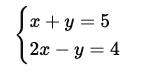
Which of the following coordinates represents the solution to the system of equations?
- (1, 4)
- (3, 2)
- (2, 3)
- (4, 1)
Answer
The correct answer is B.

FREE MAP Test Practice 9th–12th Grade Math Questions
MAP 11th Grade Math Practice Question – Computation and Operations
Melissa works as a freelance graphic designer. She charges a base fee of $1,500 per project, plus an additional 2% of the total advertising budget (b) provided by the client. She pays 10% in income tax on her total earnings.
Which of the following equations represents Melissa's income after taxes (I) based on the advertising budget (b)?
- I = 0.90(1500 + 0.2b)
- I = 0.90(1500 + 0.02b)
- I = 1500 + 0.02b – 0.10(1500)
- I = 1500 + 0.02 – 0.10(1500 + 0.02)
Answer
The correct answer is B.
Melissa earns:
A base fee of $1,500
Plus 2% of budget b, which is 0.02b
Total earnings before tax:
1500 + 0.02b
She pays 10% tax, so her income after tax is:
90% of her total earnings = 0.90 × (1500 + 0.02b)
Therefore, the correct equation is:
I = 0.90(1500 + 0.02b)
MAP 12th Grade Practice Question – Statistics and Probability
A bag holds ten marbles: four blue, three white, and three orange.
Three marbles are selected at random without replacement.
What is the probability that none of the selected marbles is blue?
- 1/6
- 1/2
- 3/10
- 4/15
Answer
The correct answer is A.
Step 1: Total ways to choose 3 marbles from 10:
This is a combination:

Step 2: Ways to choose 3 marbles that are not blue:
There are 6 marbles that are not blue (3 white + 3 orange).
So we find how many ways to choose 3 from these 6:

Step 3: Find the probability:

Correct Answer: A. 1/6
FREE MAP Test Practice 9th to 12th Grade Math Questions
MAP Test High School FAQs
What Subjects Are Covered on the MAP Test for 9th–12th Grade?
- Math: Covers a broad range of high school-level math concepts, including algebra (linear equations, inequalities, polynomials), geometry (area, volume, angles, congruence, and similarity), functions (linear, quadratic, and exponential), number and operations (rational and irrational numbers, ratios, percentages), and statistics and probability (mean, median, mode, standard deviation, data interpretation).
- Reading: Assesses comprehension of both literary and informational texts. Students analyze themes, main ideas, supporting details, tone, structure, and author's purpose. It also measures vocabulary in context and the ability to draw inferences and support answers with textual evidence.
- Language Usage: Focuses on grammar, punctuation, sentence structure, usage, and writing mechanics. It also evaluates students' abilities to revise and edit passages, improve sentence clarity, and apply correct word choice and syntax.
- Science (optional, based on school district): If given, it includes questions from life science (biology and ecosystems), Earth and space science (weather, geology, astronomy), chemistry (matter, chemical reactions), and physics (motion, energy, forces). The science section emphasizes scientific reasoning, data interpretation, and application of scientific concepts.
These subjects are aligned with Common Core and state standards.
MAP Test Practice 9th–12th Grade PDF
How Long Is the 9th–12th Grade MAP Test?
- Reading: ~40–45 questions
- Language Usage: ~50–55 questions
- Math: ~50–55 questions
- Science (if given): ~45–50 questions
The test is untimed, but each subject typically takes about 45–60 minutes.
When Is the 9th–12th Grade MAP Test Given?
- Fall – Beginning-of-year benchmark
- Winter – Mid-year progress check
- Spring – End-of-year growth measurement
Check with your school for specific test dates and subject coverage.
How Is the MAP Test Scored?
MAP uses the RIT scale to measure performance. This scale tracks academic growth and predicts future success. Students' scores are compared to national norms to show how they rank among peers, often expressed in percentiles. RIT scores help schools place students in appropriate course levels and identify needs or opportunities for enrichment.
2025 Average MAP Scores – 9th Grade
- Mathematics: Approximately 225–230 RIT
- Reading: Approximately 218–222 RIT
- Language Usage: Approximately 215–220 RIT
2025 Average MAP Scores – 10th Grade
- Mathematics: Approximately 229 RIT
- Language Usage: Approximately 219 RIT
- Reading: Approximately 221 RIT
2025 Average MAP Scores – 11th Grade
- Mathematics: Approximately 232 RIT
- Language Usage: Approximately 221 RIT
- Reading: Approximately 224 RIT
2025 Average MAP Scores – 12th Grade
- Mathematics: Approximately 233 RIT
- Language Usage: Approximately 224 RIT
- Reading: Approximately 224 RIT
These averages are based on national norms and can vary slightly depending on the testing season (fall, winter, or spring).
NWEA Practice Test 9th to 12th Grade
Why Is It Important to Score High on the MAP High School Test?
Scoring high on the MAP High School Test can open doors to advanced courses like honors, AP, or dual-enrollment, signal college readiness to educators, and strengthen applications for magnet schools, scholarships, or early college programs. It also helps identify a student's strengths for career pathway planning and builds confidence ahead of standardized tests like the PSAT, SAT, or ACT.
2025 Gifted and Talented MAP Scores – 9th Grade
- Math: 240+ RIT
- Reading: 232+ RIT
- Language Usage: 230+ RIT
2025 Gifted and Talented MAP Scores – 10th Grade
- Math: 243+ RIT
- Reading: 234+ RIT
- Language Usage: 231+ RIT
2025 Gifted and Talented MAP Scores – 11th Grade
- Math: 245+ RIT
- Reading: 236+ RIT
- Language Usage: 233+ RIT
2025 Gifted and Talented MAP Scores – 12th Grade
- Math: 247+ RIT
- Reading: 237+ RIT
- Language Usage: 234+ RIT
NWEA Practice Test 9th–12th Grade
How Can I Help My Child Prepare for the 9th–12th Grade MAP Test?
Preparing for the MAP test in high school (9th–12th grade) is crucial because these years shape college readiness and career pathways. The 9th–12th Grade MAP Test covers advanced reading comprehension, complex grammar, and higher-level math including algebra, geometry, and data analysis. Regular practice with adaptive, grade-appropriate questions helps build confidence, sharpen critical thinking, and improve test-taking skills. Using a comprehensive high school MAP Practice Pack can reinforce key concepts, identify areas needing improvement, and boost stamina for testing. Strong scores can open doors to honors, AP, dual-enrollment courses, and specialized academic programs.
NWEA 9th–12th Grade Practice Test
Have kids in multiple grades? Check out this family membership MAP Test Prep