
CogAT Practice Test
The CogAT Test is a widely used assessment that helps schools and parents understand a student's cognitive strengths and learning potential. It plays a key role in identifying gifted and talented students and guiding academic placement. Preparing for the CogAT can boost your child's confidence and improve their performance on test day. We're here to walk you through everything you need to know-from how the test works, to sample questions, and grade-level expectations.
What is the CogAT Test?
The CogAT Test (short for Cognitive Abilities Test) is a K-12 assessment designed to measure a student's reasoning and problem-solving skills. This test is commonly used to identify gifted and talented students, understand individual learning styles, and assist with academic placement. The test covers three main areas:
CogAT Verbal Reasoning Battery
Assesses a student's ability to understand and reason using words. This section focuses on vocabulary, word relationships, and verbal classification. It includes three main question types:
Picture/Verbal Analogies
Students see two words or pictures that have a relationship (e.g., "cat → kitten") and must choose the word or image that relates to a third word in the same way.
Sentence Completion
Students read a sentence with a missing word and choose the word that best completes it based on context and meaning.
Picture/Verbal Classification
Students are given three words or pictures that belong to the same group. They must identify which option from a set of five also fits in that group.
CogAT Quantitative Reasoning Battery
Measures number-based problem-solving and understanding of numerical relationships. This section helps assess how well students understand patterns and use math to reason. It includes:
Number Analogies
Like verbal analogies, but using numbers. Students must recognize how two numbers are related and apply that rule to find the missing number in a second pair.
Number Puzzles
Students solve simple math problems, such as equations with missing values or questions requiring basic arithmetic reasoning.
Number Series
Students see a sequence of numbers that follow a pattern and must select the next number in the sequence.
CogAT Nonverbal Reasoning Battery
Focuses on spatial and abstract thinking through shapes and visual patterns-no reading required. Ideal for identifying reasoning ability without the influence of language skills. It includes:
Figure Matrices
Students are shown a grid with shapes that follow a pattern. They must determine the relationship and select the shape that completes the matrix.
Paper Folding
Students visualize how a piece of paper would look after being folded and hole-punched, then choose the correct result from five options.
Figure Classification
Students are presented with three shapes that follow a visual rule. They must identify which of the answer choices best fits that same rule.
CogAT Practice Test by Grade Level
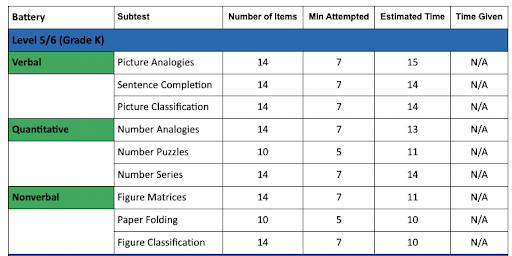
CogAT Kindergarten (Level 5/6) - Designed for children aged 5–6, this level uses pictures and simple questions to assess early verbal, quantitative, and nonverbal reasoning. It's often the first formal cognitive test students take.
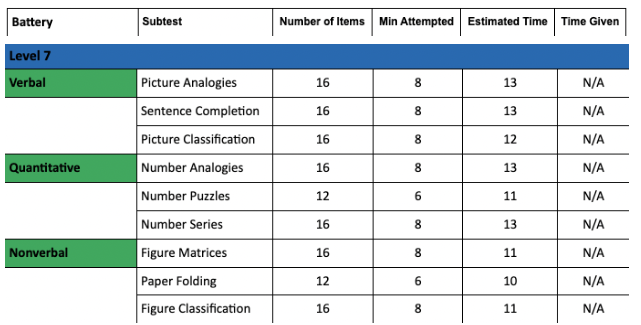
CogAT Test Grade 1 (Level 7) - Tailored for young learners who are starting to read and work with numbers independently. Includes slightly more advanced patterns and vocabulary, still supported by visuals.
CogAT Test Grade 2 (Level 8) - Introduces more structured thinking tasks. Students solve word-based and figure-based problems that require basic reading and abstract reasoning skills.
CogAT Test Grade 3 (Level 9) - Often used for gifted program screening. Covers more complex verbal analogies, number patterns, and figure classification tasks that require multi-step thinking.
CogAT Test Grade 4 (Level 10) - Involves higher-level problem-solving with an increased emphasis on vocabulary, arithmetic relationships, and visual-spatial reasoning.
CogAT Test Grade 5 (Level 11) - Expands on abstract reasoning skills. Students encounter more challenging verbal, quantitative, and nonverbal questions that assess logic and pattern recognition.
CogAT Test Grade 6 (Level 12) - Focuses on advanced cognitive skills, including critical thinking, analogical reasoning, and mathematical pattern identification. Prepares students for middle school placement and enrichment opportunities.
FREE CogAT Test Sample Questions
CogAT Kindergarten Practice Test Questions
CogAT Verbal Example
Make a connection between the images.
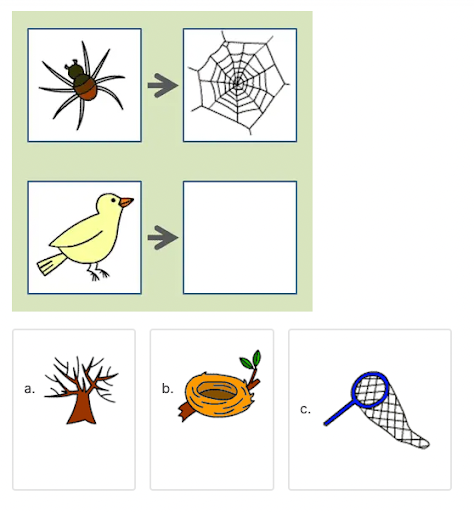
Answer
B
A spider makes and lives in a web, just like a bird makes and lives in a nest.
CogAT Quantitative Example
What follows?
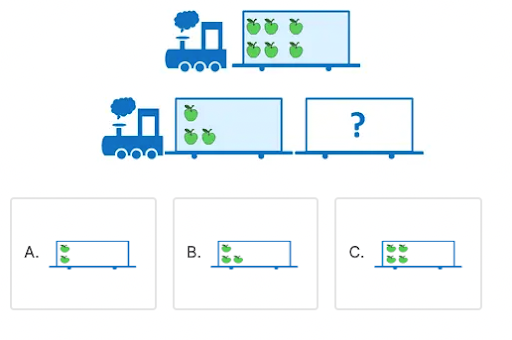
Answer
B
The first train has 6 apples, and the second has 3.
To make the total equal, we need to add 3 more apples (3 + 3 = 6).
Answer choice B. shows 3 apples, so it's the correct answer.
CogAT Nonverbal Example
Choose the next shape to follow the pattern
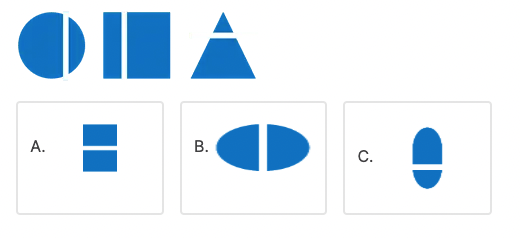
Answer
C
Each figure is split into two uneven parts (1/3 and 2/3).
Choices 1 and 2 are divided evenly, while choice 3 matches the uneven pattern-making it the correct answer.
FREE CogAT Practice Test Kindergarten
CogAT 1st Grade Practice Test Questions
CogAT Verbal Example
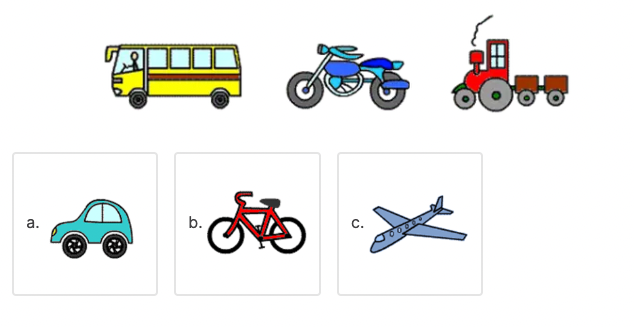
Make a connection.
Answer
A
In the top row, all items are motor vehicles that travel on roads. The bicycle is incorrect because it has no motor. The airplane is incorrect because it flies. The car is the only option that matches-it's a motor vehicle that drives on roads-so it's the correct answer.
CogAT Quantitative Example
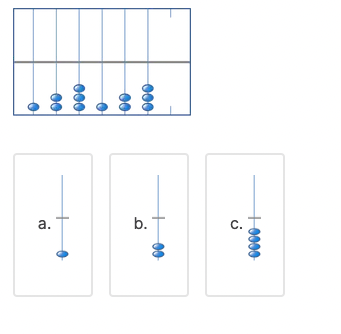
Choose what follows.
Answer
A
To find the correct answer, we follow the bead pattern: 1 bead, 2 beads, 3 beads, then it repeats. The last string has 3 beads, so the next in the pattern should have 1 bead.
CogAT Nonverbal Example
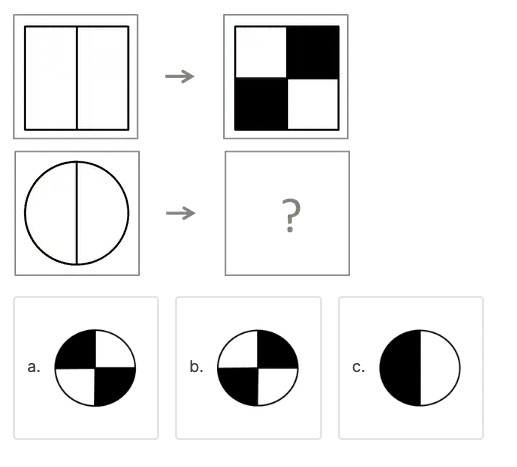
Choose the shape to follow the pattern.
Answer
B
In the top row, the figure on the right is the same as the one on the left, but it's divided into four parts, with the top-right and bottom-left shaded. In the bottom row, we need to find a figure that goes through the same change-divided into quarters with the same shading pattern.
FREE CogAT Practice Test Grade 1
CogAT 2nd Grade Practice Test Questions
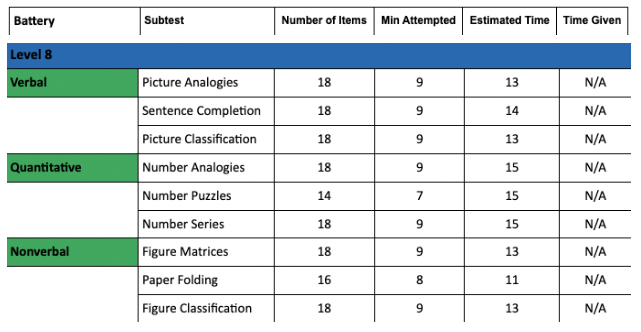
CogAT Verbal Example
The first pair of pictures at the top are connected in a specific way. Choose the picture that connects the second set of pictures in the same way.
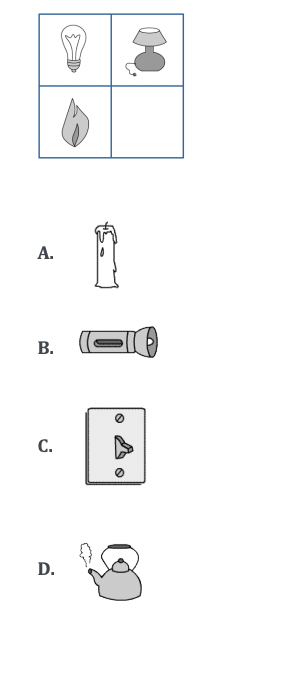
Answer
A
A light bulb provides light in a lamp, just as a flame provides light in a candle.
CogAT Quantitative Example
Choose what follows.
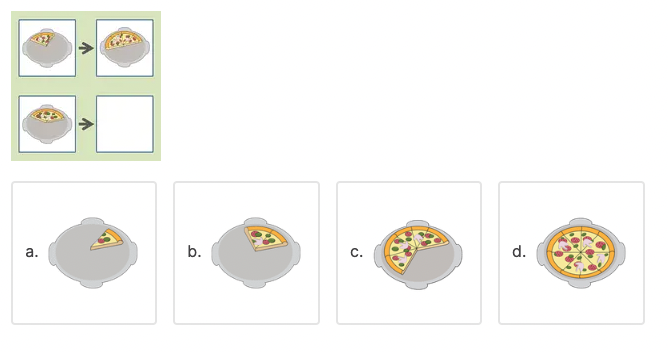
Answer
C
In the top row, 2 slices become 4 - an increase of 2. In the bottom row, we start with 3 slices, so the next frame should show 3 + 2 = 5 slices. The correct answer is the choice with 5 pizza slices.
CogAT Nonverbal Example
Choose the shape to follow the pattern.
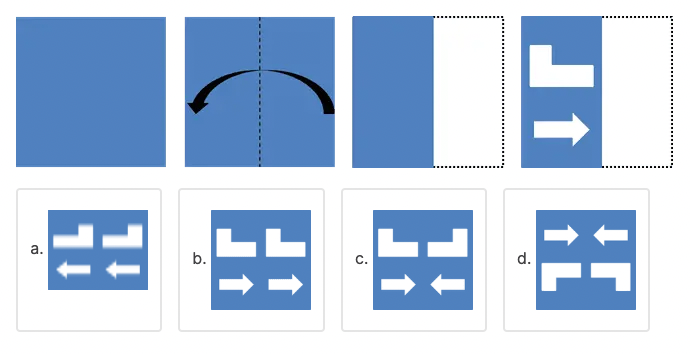
Answer
C.
First, the paper is folded in half lengthwise. An arrow and an L-shape are cut out. When unfolded, the shapes appear twice, mirrored horizontally. Choices 1 and 2 are incorrect because they don't show a mirror image. Choice 4 places the arrow above the L-shape, which is wrong. Choice 3 correctly shows the mirrored arrow and L-shape-so it's the right answer.
FREE CogAT Practice Test Grade 2
CogAT 3rd Grade Practice Test Questions

CogAT Verbal Example
The words in the first pair are related in a certain way. Choose the word that completes the second pair so that the words are related in the same way.
milk → cows : silk →
- Silkworms
- Fabric
- Cotton
- Spider
- thread
Answer
A
Milk is produced by cows, just as silk is produced by silkworms.
CogAT Quantitative Example
What number comes next in the series?
2 6 8 12 14 18 ?
- 16
- 17
- 19
- 20
- 21
Answer
C
The pattern alternates between adding 4 and adding 2: +4, +2, +4, +2, and so on.
From 14 to 18, 4 is added. Following this, we add 2 to 18:
18 + 2 = 20
Therefore, 20 is the correct answer.
CogAT Non-verbal Example
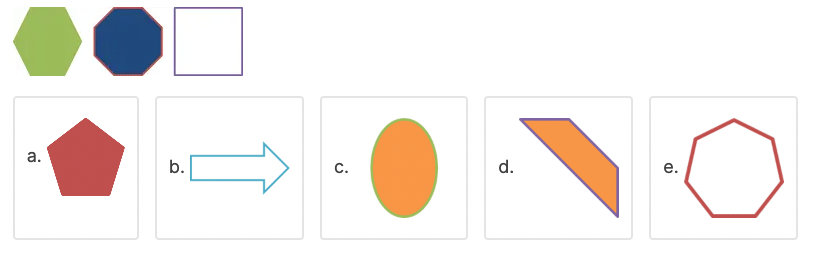
Choose the shape to follow the pattern.
Answer
D
All three shapes have an even number of sides, so the correct answer must also have an even number. Choice A has five sides, choices B and E have seven, and choice C has none. Only choice D has an even number of sides, making it the correct answer.
FREE CogAT Practice Test Grade 3
CogAT 4th Grade Practice Test Questions
CogAT Verbal Example
Find the logical connection.
carrot celery cucumber
- tomato
- spinach
- broccoli
- pepper
- lettuce
Answer
B
Carrot, celery, and cucumber are crunchy vegetables often eaten raw in salads or as snacks. Spinach is also a common leafy vegetable used in salads, making it the best match. Other options like tomato and pepper are fruits botanically, while broccoli and lettuce differ in texture and typical use.
CogAT Quantitative Example
What number comes next in the series?
[82 → 73] [45 → 36] [69 → ?]
- 60
- 55
- 62
- 65
- 58
Answer
A
Look at the pattern between the pairs: the second number is 9 less than the first.
82 − 9 = 73
45 − 9 = 36
Following the same pattern:
69 − 9 = 60
Therefore, 60 is the correct answer.
CogAT Nonverbal Example
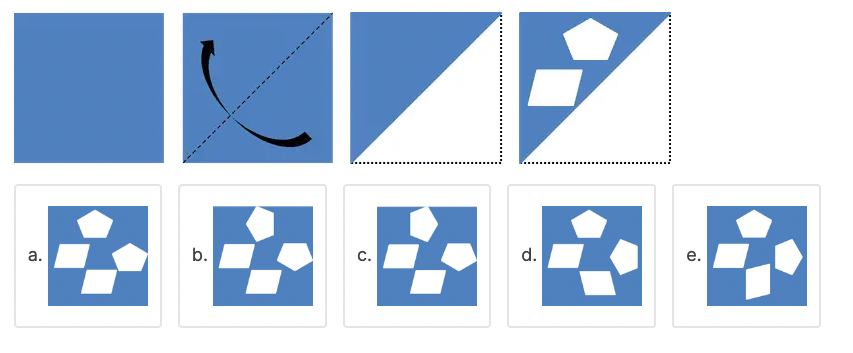
Choose the shape to follow the pattern.
Answer
E
First, the square paper is folded in half to form a triangle. Then, a pentagon and a parallelogram are cut out while folded. When unfolded, there will be two pentagon and two parallelogram cut-outs. Because the fold is along the diagonal, the second set of shapes is rotated 90° clockwise and flipped vertically.
FREE CogAT Practice Test Grade 4
CogAT 5th Grade Practice Test Questions
CogAT Verbal Example
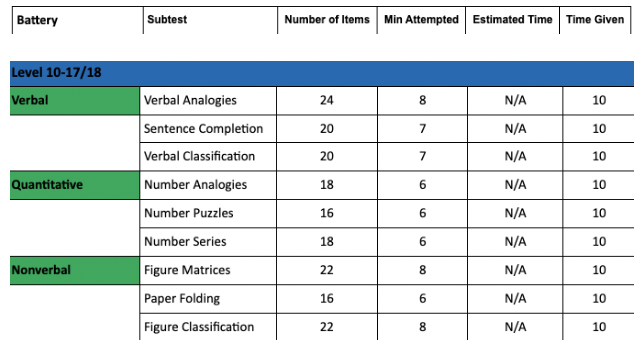
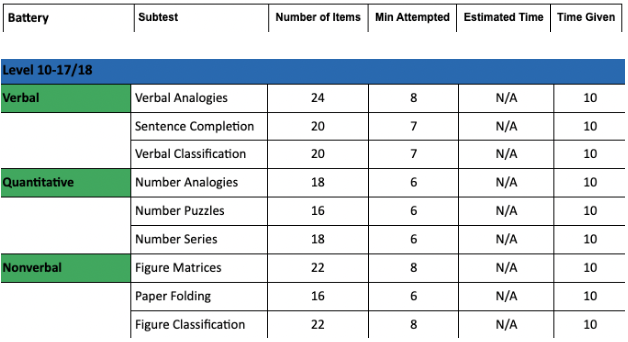
Verbal Sample Question - Sentence Completion
Choose the words that best complete the sentence.
On the surface Ben seems _____ but to all of his close peers he is _____.
- awkward .. clumsy
- peculiar .. weird
- attentive .. shallow
- shy .. outgoing
- traditional .. observant
Answer
D
Ben appears shy at first, but his close friends know he is actually outgoing.
CogAT Quantitative Example
Find the missing number.
3 × 5 = ? + 9
- 6
- 5
- 4
- 7
- 3
Answer
A
3 times 5 is 15. So, 15 = ? + 9.
Subtract 9 from 15: 15 - 9 = 6.
Therefore, the missing number is 6.
CogAT Nonverbal Example
Choose the picture that matches the bottom one in the same way the top pictures match each other.
Answer
B
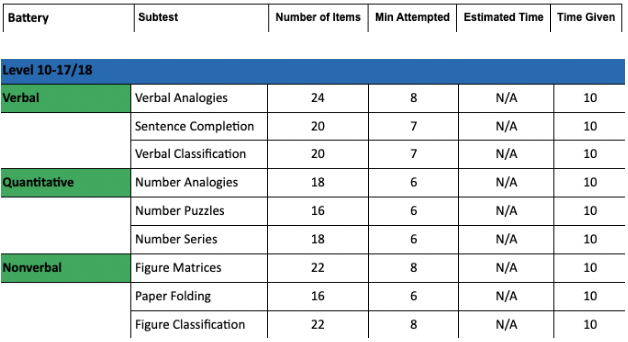
The top cells show this pattern: the bottom shape moves to the outermost position, the middle shape rotates 90° clockwise and becomes innermost, and the top shape becomes the middle.
The bottom cells follow the same rules. The bottom shape (rectangle) must be outermost-eliminate d and e. The middle shape (triangle) rotates and moves innermost, and the top shape (oval) is in the middle-eliminate a and c.
Option B matches these rules and is the correct answer.
FREE CogAT Practice Test Grade 5
CogAT 6th Grade Practice Test Questions
CogAT Verbal Example
Find the missing word.
whisper → shout : drizzle →
- flood
- sprinkle
- pour
- steam
- splash
Answer
A
Whisper is a very soft form of speaking, while shout is very loud-opposites in intensity. Similarly, drizzle is light rain, and flood is an extreme, heavy amount of water-opposites in intensity.
CogAT Quantitative Example
What number comes next in the series?
5 20 8 17 11 ?
- 13
- 14
- 15
- 16
- 17
Answer
B
The pattern alternates between adding and subtracting, with the amount changing by 3 each time: +15, -12, +9, -6, +3, ...
The last two numbers are 17 and 11. Since the pattern alternates, the next step is addition, and the amount decreases by 3 from 6 to 3.
So, 11 + 3 = 14.
CogAT Nonverbal Example
Choose the shape to follow the pattern.

Answer
D
The square paper was folded in half widthwise, then folded in half lengthwise, creating four layers. Three holes were cut through all layers, so when unfolded, there are 12 holes (3 × 4 = 12).
Answer choices A, C, and E have fewer than 12 holes and can be eliminated.
Because of the folding, each quarter of the paper should mirror the others. Answer choice B doesn't show this mirror pattern-the top and bottom halves are identical, not mirrored.
Therefore, answer choice D is correct.
FREE CogAT Practice Test Grade 6
CogAT Test FAQs
What Purpose Is the CogAT Test Used For?
The CogAT (Cognitive Abilities Test) is used by schools to assess a student's ability to reason and solve problems-not just what they've learned, but how they think. It evaluates verbal, quantitative, and nonverbal reasoning skills, which are strong indicators of academic potential.
Schools use the CogAT for several key purposes:
- Identifying Gifted and Talented Students: The test is commonly used for entrance into Gifted and Talented Education (GATE) programs, which offer more advanced or enriched instruction for high-performing students.
- Academic Placement: CogAT scores help educators determine if a student is ready for accelerated classes or needs additional support in specific areas.
- Understanding Learning Strengths: Results highlight areas where a student excels or may need support, allowing teachers to tailor their approach to better meet individual learning needs.
- Promoting Equity: Because it measures reasoning rather than learned content, the CogAT helps identify high-potential students from all backgrounds, including those who may not perform as well on traditional achievement tests.
In short, the CogAT helps schools make informed decisions about how to best support each student's growth and academic journey.
Who uses the CogAT?
The CogAT (Cognitive Abilities Test) is commonly administered in public and private schools across the United States, primarily for students in grades K–12. While it's common nationwide, certain metropolitan areas show particularly high usage. These key regions include:
- Seattle
- Dallas-Fort Worth
- Baltimore
- Atlanta
- North Carolina and South Carolina
- Washington, DC
- Chicago
- Minneapolis
- Houston
- San Antonio
If you're unsure where your child will take the CogAT, check with your school or district for specific testing locations and schedules.
How Is the CogAT Test Administered?
The test is typically given in a group setting at school, either on paper or online. Younger students often receive audio instructions and visual prompts, while older students read instructions on their own.
What Are the Different CogAT Forms?
The CogAT is offered in two main versions: Form 8 (the latest) and Form 7 (still used in some districts). Both assess the same three areas-Verbal, Quantitative, and Nonverbal reasoning-but differ slightly in format and design.
Form 8 includes updated visuals and questions aligned with current standards, while Form 7 was created with English Language Learners in mind, offering more nonverbal content to reduce language barriers.
Both forms help schools understand how students think and learn, and support decisions about academic placement and gifted program eligibility.
How Long Is the CogAT Test?
The CogAT takes approximately 90–120 minutes to complete. It's divided into three sections (batteries), with each section taking 30–40 minutes. It may be administered all at once or across multiple days.
What Are the CogAT Testing Levels?
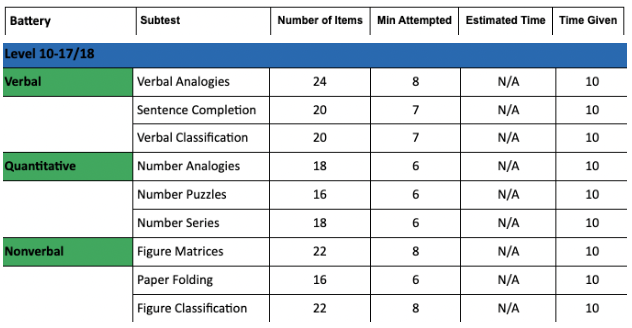
| CogAT Test Level | Grade | Number of Questions | Test Time |
|---|---|---|---|
| Level 5/6 | Kindergarten | 118 | 112 minutes |
| Level 7 | 1st Grade | 136 | 112 minutes |
| Level 8 | 2nd Grade | 154 | 122 minutes |
| Level 9 | 3rd Grade | 170 | 90 minutes |
| Level 10 | 4th Grade | 176 | 90 minutes |
| Level 11 | 5th Grade | 176 | 90 minutes |
| Level 12 | 6th Grade | 176 | 90 minutes |
| Level 13/14 | 7th – 8th Grade | 176 | 90 minutes |
| Level 15/16 | 9th – 10th Grade | 176 | 90 minutes |
| Level 17/18 | 11th – 12th Grade | 176 | 90 minutes |
What Is the Format of the CogAT Test?
The CogAT consists entirely of multiple-choice questions. It is usually given in a paper-and-pencil format, where students mark their answers by filling in bubbles on an answer sheet. However, many schools are now administering the test online, allowing students to select their answers directly on a computer or tablet. The test is carefully designed to match the student's grade level, with question types and difficulty adjusted accordingly. Whether paper-based or digital, the format remains consistent in focusing on reasoning and problem-solving skills.
When Is the CogAT Test Given?
Schools typically administer the CogAT once a year, often in the fall or spring, depending on the district's testing schedule.
What is CogAT Screening Form?
The CogAT Screening Form is a shorter version of the full Cognitive Abilities Test designed for quick initial assessment. It includes a reduced number of questions across the three main batteries-verbal, quantitative, and nonverbal reasoning-allowing schools to efficiently screen large groups of students to identify those who may benefit from further testing or placement in gifted and talented programs. Because it's shorter and faster to administer, the CogAT Screener helps educators quickly pinpoint students with strong cognitive abilities without requiring the time commitment of the full test. If a student scores well on the Screening Form, they are often invited to take the full CogAT for a more detailed evaluation.
How Is the CogAT Test Scored?
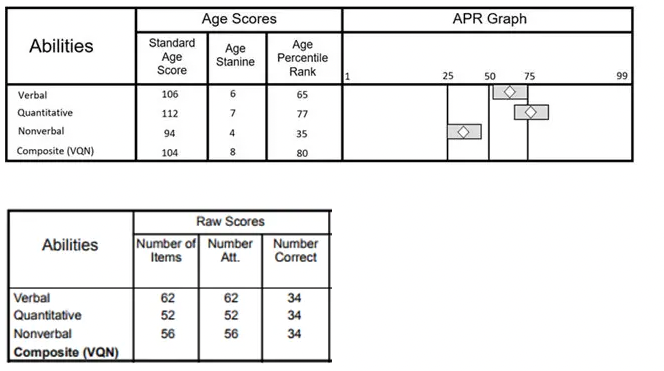
CogAT scores include three main metrics:
- Standard Age Score (SAS): Ranges from 100 (average) to 160 (very high)
- Stanine Score: A scale from 1 to 9 that groups scores into broad performance categories
- Percentile Rank: Shows how a student compares to peers nationwide
Understanding CogAT Test Results
| Stanine | SAS Band | Description |
|---|---|---|
| 9 | 130–160 | Very High (Gifted Range) |
| 7–8 | 118–129 | Above Average |
| 4–6 | 103–117 | Average |
| 2–3 | 89–102 | Below Average |
| 1 | 80–88 | Well Below Average |
CogAT Test online FREE Practice
Can You Fail the CogAT Test?
No. The CogAT isn't a pass/fail exam. It simply measures how students think and solve problems compared to others in their age group. Scores are used for placement, not grading.
What Happens if You Score High on the CogAT Test?
High scores-usually stanines 8 or 9-can qualify students for gifted and talented programs, academic enrichment, or advanced classes. Schools use these scores, along with other factors like teacher recommendations and grades, to identify students who may benefit from more challenging coursework. While criteria vary by district, a strong CogAT score helps ensure your child's abilities are recognized and supported.
Gifted CogAT Score Chart
| Score Type | Typical Gifted Cutoff |
|---|---|
| SAS | 125–130+ |
| Stanine | 8 or 9 |
| Percentile Rank | Top 5%–10% nationally |
Some schools may also require strong achievement test scores alongside CogAT results.
How Can You Prepare for the CogAT Test?
Scoring high on the CogAT can open doors to gifted and talented programs, advanced classes, and specialized learning opportunities that can shape your child's academic path. While the test measures natural reasoning skills, preparation plays a key role in building confidence, reducing anxiety, and helping your child perform at their best.
Smart preparation strategies include:
- Reviewing CogAT sample questions from each battery
- Practicing verbal, quantitative, and nonverbal reasoning tasks
- Using grade-level CogAT practice packs with clear explanations
The more familiar your child is with the test format, the better their chances of reaching their full potential.
| Kindergarten CogAT Test | 1st Grade CogAT Test | 2nd Grade CogAT Test |
| 3rd Grade CogAT Test | 4th Grade CogAT Test | 5th Grade CogAT Test |
| 6th Grade CogAT Test |
Have kids in multiple grades? Check out this family membership CAT4 Test Prep