SCAT Practice Test
Are you preparing your child for the Johns Hopkins Center for Talented Youth (CTY) programs? The SCAT Test is a respected assessment used by Johns Hopkins Center for Talented Youth to identify gifted students and measure advanced reasoning skills. This is the first hurdle your child must pass to get accepted to their prestigious gifted programs. Preparing for the SCAT can boost your child's confidence and improve their test performance. We're here to guide you through everything-from how the test works, to practice questions, and grade-level expectations.
| Elementary SCAT Practice Test | Intermediate SCAT Practice Test | Advanced SCAT Practice Test |
What is the SCAT Test?
The SCAT Test (School and College Ability Test) is a standardized exam developed by the Johns Hopkins Center for Talented Youth (CTY) to identify gifted students in grades 2-12. Used primarily for admission to CTY's gifted programs, the SCAT is an above-grade-level test, meaning students take a version intended for older students to better measure their reasoning skills.
The SCAT assesses two key areas:
- Verbal Reasoning: Understanding word relationships through analogies.
- Quantitative Reasoning: Solving problems using numerical relationships and number pairs.
SCAT Practice Test by Level
Elementary SCAT (Grades 2-3) - Designed for younger gifted students, this level uses questions intended for grades 4-5. It includes basic word analogies and number pairs to assess verbal and quantitative reasoning. A great introduction to above-grade-level testing.
Intermediate SCAT (Grades 4-5) - Students take a test designed for grades 6-8. The analogies and math problems become more challenging, requiring stronger vocabulary, number sense, and logical thinking.
Advanced SCAT (Grades 6 and above) - Uses test content from grades 9-12. Students solve complex verbal and numerical reasoning problems under timed conditions.
Free SCAT Elementary Test Practice Questions
SCAT Verbal Reasoning Sample Question - Elementary Level
Find the lettered pair of words that go together in the same way as the first pair of words.
Library : books ::
- bakery : bread
- school : teacher
- park : trees
- kitchen : food
Answer
A
A library holds books, just like a bakery has bread.
SCAT Quantitative Reasoning Sample Question - Elementary Level
Which column shows the larger percentage?
Column A: 40% of 80
Column B: 30% of 100
- Column A is greater
- Column B is greater
- The two parts are equal
Answer
A
40% of 80 = 32, 30% of 100 = 30. So, Column A is greater.
Free SCAT Intermediate Test Practice Questions
SCAT Verbal Reasoning Sample Question - Intermediate Level
conflict : struggle ::
- harmony : peace
- chaos : order
- problem : solution
- silence : noise
Answer
A
A conflict is a type of struggle, just like harmony is a type of peace.
SCAT Quantitative Reasoning Sample Question - Intermediate Level
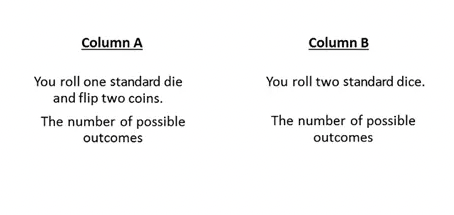
Answer
B
Column A has 6 × 2 × 2 = 24 outcomes.
Column B has 6 × 6 = 36 outcomes.
36 is greater than 24.
Free SCAT Advanced Test Practice Questions
SCAT Verbal Reasoning Sample Question - Advanced Level
ambiguous : unclear ::
- meticulous : careless
- ephemeral : fleeting
- resilient : fragile
- candid : deceptive
Answer
B
Ambiguous means unclear, just as ephemeral means fleeting.
SCAT Quantitative Reasoning Sample Question - Advanced Level
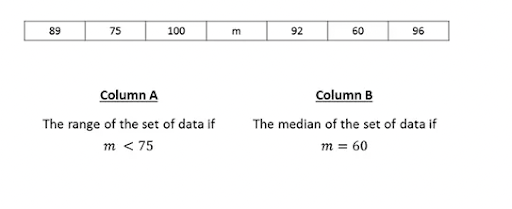
Answer
D
The range in Column A changes depending on m, and the median in Column B varies with m. So, it is not possible to determine which is always greater.
Free SCAT Advanced Test Practice Questions
SCAT Test FAQs
What Purpose Is the SCAT Test Used For?
The SCAT Test is primarily used as part of the admissions process for Johns Hopkins Center for Talented Youth (CTY) programs. A qualifying SCAT score can give your child access to:
- CTY Online Programs (Grades 2-12): CTY's Online Programs offer enrichment and accelerated courses in math, science, writing, and more—tailored for advanced learners. These rigorous courses can be taken from anywhere, at any time, and are designed to match each student 's pace and academic goals. Formats include Individually Paced options with instructor support, Session-Based courses with fixed schedules, LIVE real-time virtual classes, and short Clubs focused on specific topics.
- CTY On-Campus Summer Programs (Grades 2-12): CTY's On-Campus Summer Programs offer rigorous, in-person academic experiences on select university and school campuses. These three-week programs bring together advanced students from around the world to learn, connect, and grow in a supportive, challenging environment. Options include Day Programs for grades 2-5 and Residential Programs for grades 5-12. Students can choose from program types such as Discovery Sampler (grades 3-8), Young Students Program (grades 2-6), Academic Explorations (grades 7+), and Intensive Studies (grades 7+), covering subjects from math and science to writing and more.
How Do You Register for the SCAT Test?
- Create a MyCTY account on the Johns Hopkins CTY website.
- Pay the one-time membership fee ($50 for U.S. students, $60 for international).
- Establish eligibility for CTY programs by either:
- Taking the SCAT or another CTY-administered test (e.g., PSAT™ 8/9, Spatial Test Battery), or
- Submitting qualifying scores from accepted tests like the CogAT, MAP Growth, Iowa Assessments, PSAT, SAT, or ACT Aspire. Scores must be from after July 1, 2017, show the student 's name and test, and typically be at the 98th percentile or higher or two grade levels above in key areas
Who uses the SCAT Test?
The SCAT Test is used by the Johns Hopkins Center for Talented Youth (CTY) to identify academically gifted students in grades 2-12. Parents, educators, and school counselors may recommend the test to assess a child 's eligibility for CTY 's advanced online and summer programs.
How Long Is the SCAT Test?
The SCAT Test takes approximately 1 hour to complete. Here's the breakdown:
- Verbal Section - 22 questions
- Quantitative Section - 22 questions
- Total Questions: 44 (plus a few unscored experimental items
Students should plan for about 60 minutes total, including instructions and break time.
What Is the Format of the SCAT Test?
The SCAT Test consists of two main sections, each with multiple-choice questions designed to assess reasoning skills:
- Verbal Reasoning:
- Focuses on word relationships and analogies
- Example: "Cat is to Kitten as Dog is to ____?"
- Quantitative Reasoning:
- Focuses on numerical relationships and problem-solving with number pairs
- Example: "3 is to 6 as 4 is to ____?"
What Are the SCAT Testing Levels?
| SCAT Level | Grades | Test Content | Time |
|---|---|---|---|
| Elementary | 2-3 | Grades 4-5 | ~60 min |
| Intermediate | 4-5 | Grades 6-8 | ~60 min |
| Advanced | 6+ | Grades 9-12 | ~60 min |
When Is the SCAT Test Given?
The School and College Ability Test (SCAT) is administered by the Johns Hopkins Center for Talented Youth (CTY) on a flexible schedule, offering two main testing options:
- Online (At-Home): Flexible, ends June 30
- Availability: Students in grades 2-12 can take the Online SCAT anytime at home on a desktop, laptop, or Chromebook that meets the technical requirements.
- Registration Deadline: Registration for the Online SCAT usually occurs annually in the spring time around the month of June.
- Prometric Centers: Varies by location
- Availability: Students can take the SCAT at any Prometric test center worldwide.
- Scheduling: Testing dates and availability vary by location. It's recommended to locate a test center and schedule the test through the Prometric CTY page.
How Is the SCAT Test Scored?
The SCAT Test is scored based on the number of correct answers in its two sections:
- Raw Score: Total number of correct answers in Verbal and Quantitative sections (out of 44 questions).
- Scaled Score: Raw scores are converted to scaled scores to adjust for test difficulty across different levels.
- Percentile Rank: Students receive a percentile ranking that compares their performance to other students in the same grade nationwide.
To qualify for CTY programs, students typically need to score at or above the 95th to 99th percentile, depending on the program and grade level.
What Score Does My Child Need for JHU CTY Programs?
To qualify for Johns Hopkins Center for Talented Youth (CTY) programs, students must meet specific eligibility criteria based on their SCAT test scores. These criteria vary by grade level and are categorized into different eligibility levels:
Eligibility Levels:
- CTY-Level: Indicates ability approximately two grade levels above the student's current grade.
- Advanced CTY-Level: Indicates ability approximately four grade levels above the student's current grade.
- Emerging: Select CTY courses do not require minimum test scores.
SCAT Score Requirements
The following tables outline the minimum SCAT scaled scores required for each eligibility level, based on the student's grade at the time of testing:
Grades 2-8:
| Grade | CTY-Level Verbal | CTY-Level Quantitative | Advanced CTY-Level Verbal | Advanced CTY-Level Quantitative |
|---|---|---|---|---|
| 2 | 428 | 433 | 438 | 443 |
| 3 | 433 | 438 | 443 | 448 |
| 4 | 438 | 445 | 448 | 458 |
| 5 | 443 | 455 | 453 | 470 |
| 6 | 448 | 468 | 458 | 480 |
| 7 | 453 | 473 | 463 | 488 |
| 8 | 458 | 480 | 470 | 495 |
Grades 9+:
| Grade | CTY-Level Verbal | CTY-Level Quantitative | Advanced CTY-Level Verbal | Advanced CTY-Level Quantitative |
|---|---|---|---|---|
| 9+ | 463 | 488 | 478 | 503 |
Note: These scores are based on testing conducted between July 1 and December 31. For testing outside this period, refer to the official CTY eligibility guidelines.
What Happens if You Score High on the SCAT Test?
Qualify for Johns Hopkins CTY Programs
Access advanced online courses, summer programs, and academic camps designed for gifted students.
Gain Academic Recognition
Their high score shows strong verbal and quantitative reasoning skills, helping schools and educators understand their potential.
Open Doors to Other Gifted Programs
Some schools and organizations accept SCAT scores for placement in gifted and talented programs beyond CTY.
How Can You Prepare for the SCAT Test?
To prepare effectively for the SCAT Test, taking a SCAT full-length Practice Test is key. SCAT Prep helps students become familiar with the format, question types, and timing, reducing test-day anxiety. Alongside this, working on verbal analogies and number patterns sharpens the reasoning skills needed for success. Regular practice builds confidence and improves performance.
Have more than one child taking the SCAT Test? Check out this family membership SCAT Test Prep.